


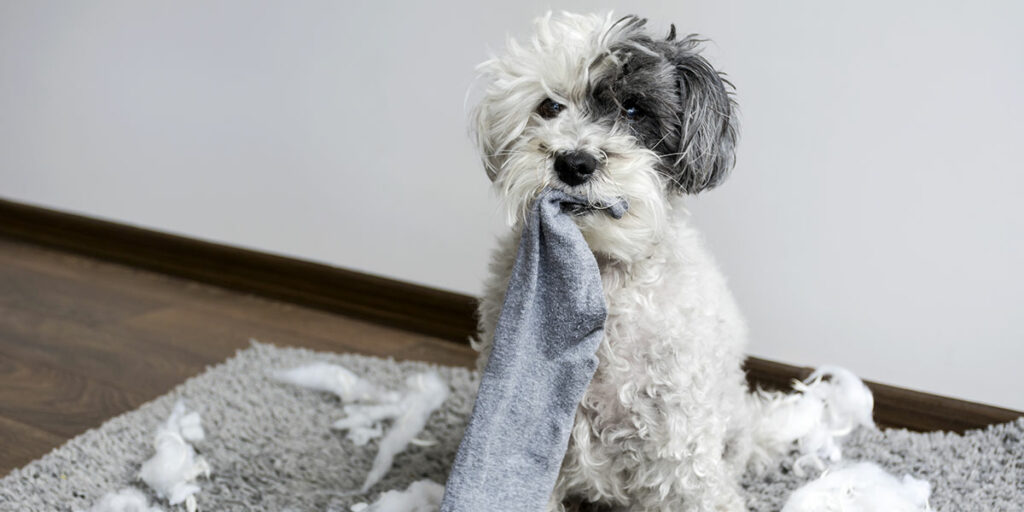
Why does my dog get anxious when left alone? Great question! I get quite a few requests from owners on separation anxiety.
Therefore I’m going to address it in three separate articles, namely:
PART 1 – WHY DOES MY DOG GET ANXIOUS WHEN LEFT ALONE?
PART 2 – DOES MY DOG SUFFER FROM SEPARATION DISTRESS?
PART 3 – HOW TO PREVENT SEPARATION DISTRESS.
So without further ado – welcome to PART 1. Let’s begin:
WHAT IS SEPARATION ANXIETY?
Everyone has heard the term separation anxiety. Did you know that it’s just one response to social isolation that dogs can experience?
In the past, separation distress was a blanket description used for just about any dog who acted up. Especially when left alone. Be it them digging holes to chewing furniture.
However, thanks to modern research in animal behaviour, it’s clear there are many reasons why dogs do what they do when you’re away.
Therefore, separation distress is a better term for dogs who experience emotional fluctuations when separated from their owners.
SEPARATION ANXIETY VS. SEPARATION DISTRESS
This differentiation is important. Not all distressed dogs are anxious.
Anxiety originates in a very specific part of the brain; and not all emotional responses to social isolation originate in the same place.
The parts of the brain involved in anxiety responds differently to medication than the parts of the brain involved with pleasure.
So it’s really important to know what your dog feels when left alone before asking for medication to make him better.
Many dogs suffer from separation distress. Often their owners aren’t aware of it, because they don’t actively show signs of this distress. Many will lie in front of the door or pace non-stop. Since there’s no damage visible the owners do not know about it.
When a behaviourist is called in to help a dog who experiences separation distress, a lot of time is spent evaluating the dog and his relationship with his owner. A consultation can take up to two hours!
WHAT CAUSES THAT OVER-ATTACHMENT IN DOGS?
If your dog hasn’t had much experience with being left alone before he was 6 weeks old, then it’s likely that he may have become sensitized to the experience.
Puppies need to learn to cope and relax. Especially when alone before the age of 6 weeks, when their brains become mature enough to experience panic. Panic is the natural response to social isolation for young mammals, as it can be very dangerous.
At certain ages, (and this differs from species to species) mammal babies start to become more mobile and will leave the den / nest area.
Mother nature designed them with a built-in mommy proximity meter. This activates more or less the same time as the ability to be more mobile and able to leave the protection of the den. When they start to explore, they need to still stay close to mom, as that’s who is keeping them alive and safe.
When they’ve had the onset of the ability to experience panic, they will experience psychological pain when they are too far away from mom. That pain motivates them to hurry up and get closer to mom, so it’s nature’s safety net. Pretty amazing isn’t it?
WHAT PREVENTS THE YOUNG PUP FROM BEING A MESS WHEN LEFT ALONE?
Before 6 weeks in dogs, his mom would leave him for short periods of time. She may even drag each pup away from the rest for short periods of time, leaving the pup there on his own. Because he can’t experience panic yet, he will usually lie still or slowly investigate the environment around him. Or he’ll fall asleep.
What’s really happening is he’s learning an important lesson: when I’m alone, it’s not the end of the world. Investigate, sleep or just wait, and someone will come and get me.
He doesn’t panic, because he can’t yet. He may be scared, and he may call out, but the impact is not as intense as after 6 weeks of age because he’s only capable of a limited range of emotional responses.
If a puppy experiences isolation for the first time when he’s 8 weeks old and in a new home, it’s likely to have a huge impact on him and he’s likely to cry a lot.
Humans (and mammals) aren’t great at ignoring a crying baby, whether it’s a two or four legged one.
When the puppy’s owner responds by picking him up or sleeping with him, he feels an intense sense of relief, and the bond between owner and puppy is strengthened. It’s called the CARE system, and it’s responsible for all social bonds that we form.
The CARE system and the PANIC systems in the brain work together.
When the CARE system is interrupted or severed, the PANIC system kicks in, and its job is to motivate the animal to get back to the lost person of affection.
It’s really important to know what your dog really feels when left alone before asking for medication to make him better.
We see it in humans to.
Think about past relationships you’ve had. Ever heard the expression, I was heartbroken when we broke up?
Anyone who’s ever been through a relationship that ended will tell you that it does feel like your heart has been broken, and you really do feel pain. That’s because it hurts, even though your heart hasn’t physically been broken!
When we love someone, we have the activation of the CARE system. And when that person leaves, the PANIC system kicks in. It tries to get us to go back to the person, because it makes us feel better and it stops the pain.
Of course, it’s not always a good idea, in the case of human exes!
When the bond is severed (in the case of distress, anxiety or terror) the dog will try a variety of things to get back to the owner.
He may vocalise (howl or bark), he may eliminate, he may even destroy things. Whatever he does will provide him with some emotional relief, which is why it becomes his go-to plan so quickly.
I mentioned different kinds of responses to isolation, and we’ve covered the fear/anxiety component above.
Some dogs get angry when their owners leave, and these are usually dogs of a certain character or disposition.
Terriers are more likely to get really angry when their person leaves and will often resort to aggression to keep the human home.
WHAT ABOUT DOGS WHO FEEL PLEASURE AT BEING LEFT ALONE?
In some cases, the only opportunity the dog gets to engage in doggy behaviours is when the owner isn’t home. That’s when he gets to chew / dig / destroy toys. The rest of the time, when his owner is home, he can’t.
So those dogs are absolutely delighted when their owners leave, because to them, that’s fun time!
Unfortunately, destruction looks like destruction … so whether the dog was happy / angry / scared.
And barking sounds like barking. Sure, to be honest, different tones have different meanings, but the underlying emotional responses all vary. Thus would influence how you address the problem.
If a dog is happy about being left alone, you’d treat the differently than to when he’s absolutely terrified. If you use the wrong protocol on the wrong emotional state, you risk making the problem worse.
That’s why separation distress is a tricky problem to address; and why it’s something that must be seen in person.
CONCLUSION
If you suspect your dog may be suffering from separation distress, don’t wait, get in touch today. The longer the problem exists, the harder it is to resolve.